Every field on every Strategy record: what it asks for, why it matters, and an example.
The Strategy concept page covers the shape. This is the field reference: what each one is asking for, and what a good answer looks like.Every field is asking one question. What do you actually know about this, and how would the reader say it themselves?
Examples below are illustrative, built around a home-warranty offer. They are not from any live account.
The five tabs form one chain. Build from the thing you sell toward the copy a visitor sees. Each step gives the next one something concrete to attach to.
1
Add a Product
What to do. Open Strategy → Products → New product and name what you sell. Add its current capabilities, planned capabilities, limitations, and qualified outcome when you have them.Why it matters. The Product is the root of the tree. Every ICP, Angle, Research entry, and copy line needs something real to point back to.
Strategy, then Products: start with the thing you sell
2
Define the ICP
What to do. Open Strategy → ICPs → New ICP and describe the person in terms of goals, triggers, beliefs, objections, and language rather than only demographics.Why it matters. Copy briefs are built for a named audience. Without an ICP, the agent has no specific reader to write for, and copy aimed at everyone reads as if it is aimed at no one.
Strategy, then ICPs: define who buys and what moves them
3
Create the Offer or Angle
What to do. Open Strategy → Offers/Angles → New angle and connect a Product to an ICP with one persuasive argument. State the problem, desired outcome, mechanism, proof, qualification, and disqualifiers.Why it matters. The Angle is the thesis a page or ad argues. Two angles with different mechanisms create a useful test; two rewrites of the same claim usually do not.
Strategy, then Offers/Angles: one audience, one product, one argument
4
Attach Research
What to do. Open Strategy → Research → New research and save the source, evidence, and takeaways. Link the entry to the Product, ICP, or Angle it supports.Why it matters. Research is where a claim earns the right to be made. It preserves the original evidence and connects a strategy decision to an actual receipt.
Strategy, then Research: preserve the evidence behind the argument
5
Build the Copywriting library
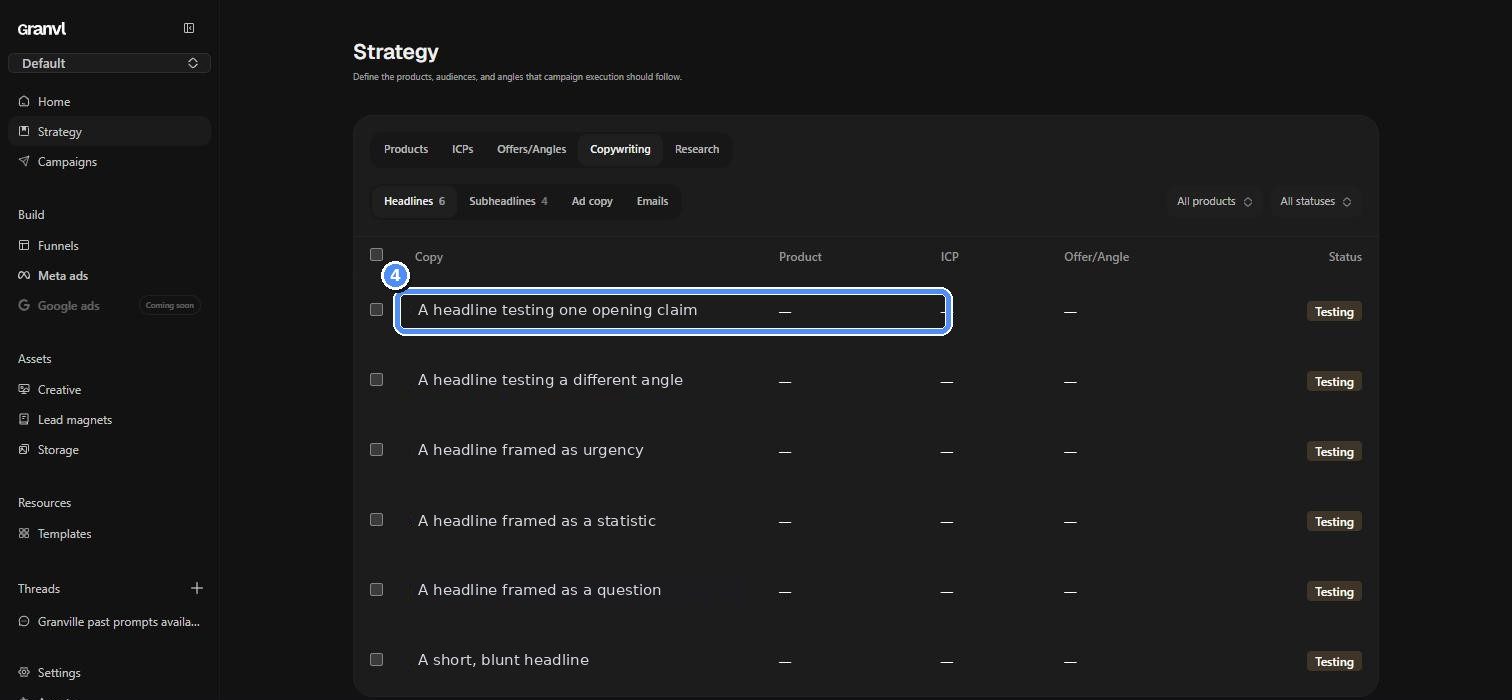
What to do. Open Strategy → Copywriting to review headlines, subheadlines, and ad lines written by an agent. Filter by Product, ICP, Angle, status, kind, or surface.Why it matters. Saving copy makes the library compound. A proven line can be adapted, a weak line can be archived, and the rationale preserves why each line was written.
Strategy, then Copywriting: every line stays tied to its strategy and rationale
There is no blank “New copy” form. Lines are generated by an agent and save as testing. Only warehouse-backed experiment results can promote a line to winner.
The sections below are the field-by-field reference for each step.
Strategy → Products → New product. The root of the tree. Every ICP, angle, and copy line traces back to one.
New product: two fields, one required
Field
What it asks for
Example
Name (required)
A short label for what you sell
”Home Warranty Plans”
Description
What it is and who it serves, in a sentence or two
”Annual coverage for home systems and appliances, for homeowners past their builder’s warranty.”
Destination URL
Where a visitor lands to buy or learn more
The offer page this product sells
Current capabilities
What the product does today
”Covers HVAC, plumbing, electrical, and six named appliances.”
Planned capabilities
What is coming but has not shipped
”Roof coverage, Q4.”
Limitations
What it does not do, honestly
”No coverage for pre-existing failures or cosmetic damage.”
Qualified outcome
What counts as a qualified lead or purchase
”Homeowner, property over 5 years old, not currently covered.”
Status
draft, active, or archived
Current and planned capabilities are never merged when a brief is built. This is the mechanism that stops copy promising a roadmap item as a shipped fact. Put a future feature in planned, not in current, even when it is two weeks out.
”Expand. Best conversion rate of any ICP in the last 30 days.”
Confidence
How well evidenced this is: strong, moderate, limited
Status
proposed, draft, active, or archived
Notes
Anything else worth keeping
”Skews older. Avoid overly casual copy.”
Product(s)
Which products this ICP applies to
”Home Warranty Plans”
It is tempting to fill an ICP in with a job title and an age range. The fields are deliberately shaped around goals, triggers, beliefs, and objections instead. A demographic tells the ad platform who to target. This tells your agent what to say.
Strategy → Offers/Angles → New angle. The persuasive thesis: one or more products, one or more ICPs, and one argument.
New angle: the promise, an optional incentive, and who it targets
Field
What it asks for
Example
Name
A short label for the argument
”Beat the auto-renewal”
Problem / pain point
The specific problem this angle leads with
”Their plan renews automatically at a higher rate if they miss the cancel window.”
Desired outcome
The dream state the promise delivers
”Lock in today’s rate with zero risk of an unwanted renewal.”
Mechanism
How the product actually gets them there
”We read your renewal date off the policy and quote against it before the window closes.”
Proof
Evidence the promise holds
”Average $340 saved across 1,200 switchers last year.”
Objection handled
The objection this angle exists to defuse
”Everyone claims cheapest, so the claim is doing no work.”
Qualification
Who this offer is for
”Homeowners with a renewal inside 60 days.”
Disqualifiers
Who it is not for
”Renters, and anyone mid-term with no renewal in sight.”
Incentive
The sweetener, if any
”Price-match guarantee for 12 months.”
Price / terms
Price and terms as stated to the buyer
Confidence
strong, moderate, or limited
Status
proposed, draft, testing, active, or archived
ICP(s) and Product(s)
What this angle targets and sells
An angle must name at least one of the two
Mechanism is the field that separates a real test from a reworded one. Two angles arguing different mechanisms teach you something when one wins. Two angles rewording the same claim teach you which sentence scanned better.
Strategy → Research → New research. Evidence, not opinion. The thing an angle points back to when someone asks how you know that.
New research: a title, a kind, the evidence, and what it supports
Field
What it asks for
Example
Title
A short label for this piece of evidence
”Reddit thread: renewal price shock complaints”
Kind
The category: transcript, competitor, survey, review, and so on
”Transcript”
Source URL
Where it came from, if anywhere
A link to the original thread or interview
Body
The actual quotes, findings, or excerpts
”Didn’t realize it auto-renewed until the charge hit. Wish there was a reminder.”
Takeaways
The findings, one per entry, written to be read on their own
”Surprise is the emotion, not price. Lead with the date, not the discount.”
ICP / Angle / Product
What this evidence supports. Defaults to unassigned
Linked to the matching ICP
Takeaways are what a brief leads with; the body is the long-form backing detail. An entry with a body and no takeaways still reads as its body, so nothing is lost by adding evidence fast and summarizing it later.
Strategy → Copywriting. There is no creation form here. Lines are written by your agent, either directly or while building a page. Clicking a line opens its detail panel.
A copy line in detail: the text, what it targets, and why it was written
Field
What it asks for
Example
Body
The copy itself
”Lock in your rate before the renewal window closes.”
Kind
headline, subheadline, ad_primary, ad_headline, or ad_description
Surface
Where it runs: landing or ad
A headline is written differently for a page than for a feed
Status
testing, winner, or archived
Source
agent, human, or imported
Rationale
Why this line was written this way
”Mirrors the current ad headline closely to reduce post-click message mismatch while keeping the qualification marker.”
Batch
A free label for lines drafted in one pass
”hero test 3”
Targeting
The product, ICP, and angle it argues from
The linked triple
The rationale is the difference between the agent wrote this and the agent wrote this because. It is what a human reads when deciding whether a line deserves promotion.
Copy is not signed off, it wins a test or it does not. Only warehouse-backed experiment results move a line to winner; your agent cannot promote its own work. Archive retired lines rather than deleting them, since the library is also the record of what was tried.
One bounded product + ICP + angle brief with linked evidence and explicit gaps
get_copy_brief
The same brief plus existing copy lines and the exact copy gaps for an ad or page
list_copy_lines
Read the library, filtered by kind, surface, status, angle, or ICP
create_copy_lines
Save a batch of new lines, each with a rationale
update_copy_line
Edit one line or change its status
Products, ICPs, angles, and research are authored in the dashboard, by you or by granvl’s built-in agent, which has its own tools for creating and updating them. Your MCP-connected agent reads them through the brief tools and tells you what is missing.