A screenshot-led walkthrough of funnels, campaigns, and tracking once setup is complete.
The quickstart covers the path from a blank workspace to a live, tracked funnel. This page is the day-to-day map: what to open, what to read first, and what action to take next.
Meta is the live native ad channel. Your agent can bring spend and campaign structure from other platforms into granvl with record_ad_entities and record_ad_spend, so those numbers can still sit beside first-party conversions.
What to do. Open Funnels, sort by visitors, conversions, or conversion rate, and filter by domain, platform, or date range. Each row reports traffic and conversions for the window you selected.Why it matters. This is the fastest way to see which offers are pulling their weight before you spend time inside any one funnel.
The Funnels list: sort, filter, then open the funnel that needs attention
2
Read the funnel's health first
What to do. Open a funnel and read the top bar for the selected window: leads, conversion rate, and visitors, with the trend line below.Why it matters. These are the same three first-party numbers granvl checks before suggesting an optimization. Read them before changing copy, traffic weights, or budget.
Every funnel opens on leads, conversion rate, and visitors
3
Compare the variants
What to do. Scroll to the variant table. Review traffic split, visitors, conversions, and conversion rate. granvl marks the current leader, and Archive lets you retire a variant without losing its history.Why it matters. The table shows what is leading, but an early lead is not automatically trustworthy. Use the traffic and confidence thresholds before acting.
The variant table: weights, per-variant results, and the current leader
Do not act on fewer than about 100 visitors per variant. Promotion and pause decisions have stricter requirements. See When a result is safe to act on.
4
Inspect where visitors drop off
What to do. Continue to the step canvas to compare movement between pages. On quiz and form pages, open the question-level breakdown.Why it matters. A page can have a healthy overall conversion rate while one step or question is losing most visitors. The drop-off view tells you where the next test belongs.
Campaign reporting has two levels: a cross-platform overview and the row-level detail inside a channel.
1
Begin with the Campaigns overview
What to do. Open Campaigns and review revenue, ad spend, ROAS, leads, and CPQL for the selected date range, channel, and status.Why it matters. Start with one question: is cost per qualified lead moving in the direction you want? That tells you whether the issue deserves a deeper campaign, funnel, or qualification review.
Campaigns overview: spend, ROAS, leads, and CPQL across platforms
2
Drill into Meta
What to do. Open Meta ads and move between Campaigns, Ad sets, and Ads. Sort the table by spend, CPC, CPM, CTR, Meta conversions, or granvl conversions. Open an ad thumbnail to inspect the full creative.Why it matters. Meta’s conversion count and granvl’s first-party count are two different signals. Reading them side by side is how you catch drift between platform attribution and what actually happened on your funnel.
Meta reporting: platform conversions and granvl conversions beside each other
3
Use a Campaign Hub for one initiative
What to do. Group a funnel and its related ad campaigns into a named hub, usually one per brand, offer, or marketing initiative.Why it matters. A hub rolls up spend, traffic, and conversions from the linked platforms without changing or owning the underlying funnel and campaigns.
granvl’s first-party count for the same traffic, joined independently of the platform pixel
Beside the platform number
CPQL
Spend divided by qualified leads rather than every form submission
Campaigns overview and Meta ads
ROAS
Revenue divided by spend once a conversion source reports revenue
Campaigns overview
A campaign can look cheap on raw conversions and expensive on CPQL. That gap is often the more honest signal. ROAS stays empty until a CRM, store, or record_external_conversion reports revenue back.
Tracking is set once per domain, not once per campaign. When reporting looks wrong, check the domain before diagnosing the campaign.
1
Check status for the domain
What to do. Open Settings → Tracking and find the domain used by the funnel. Review the status for each configured platform.Why it matters. A broken pixel often under-reports without throwing a visible error. This should be the first check when spend and conversions stop agreeing.
Tracking status, per domain and per platform
2
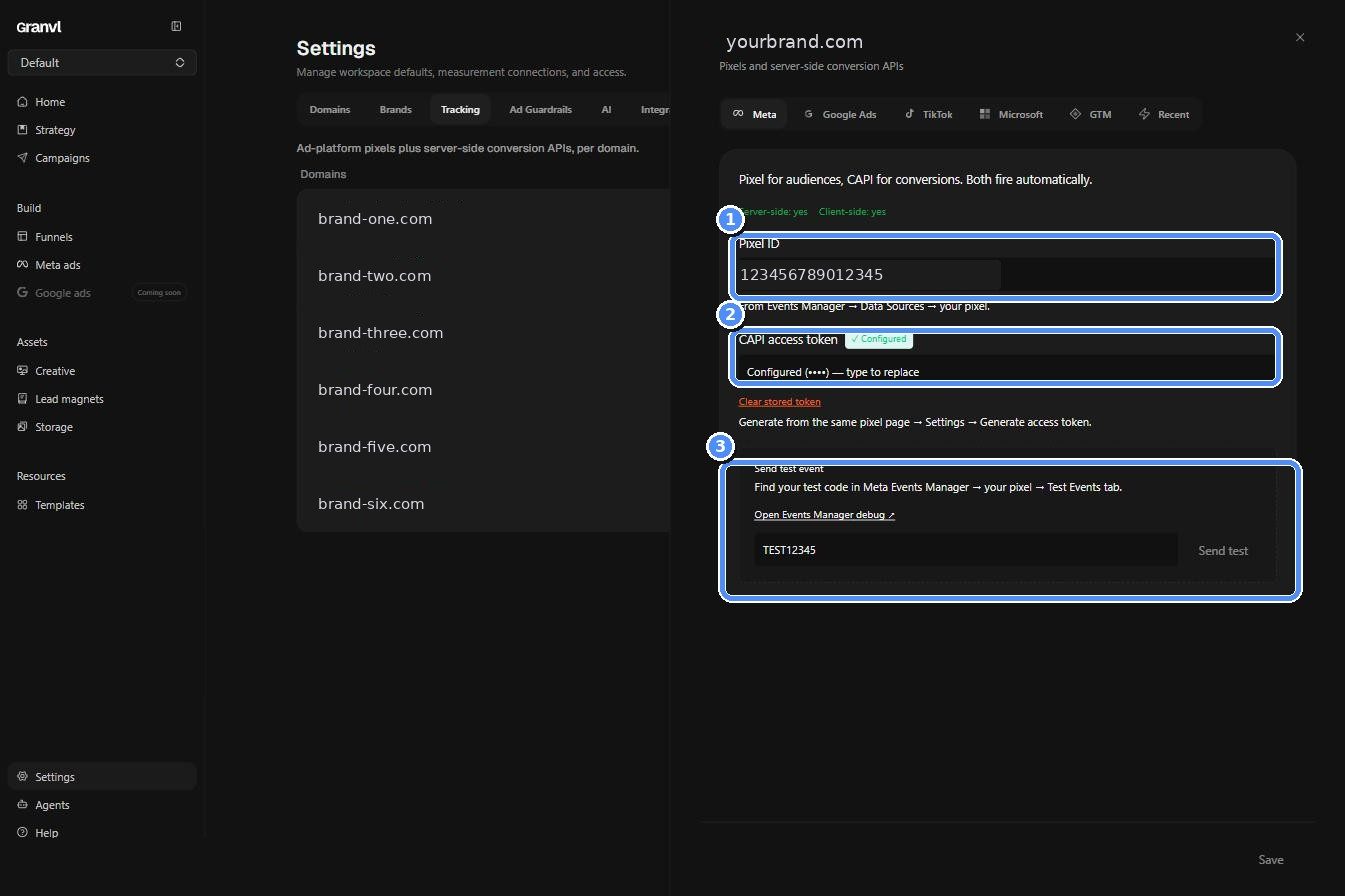
Send a test event
What to do. Open the domain’s platform configuration and use Send test event to fire a synthetic conversion through the platform’s own debug tools.Why it matters. This confirms that an event actually arrives. Saved credentials alone only prove that values were entered.
Open the pixel configuration and send a test event
When campaign reporting looks wrong, verify tracking before changing the campaign. A silently broken pixel is a more common explanation than a sudden performance collapse.
If an ads read is empty, ask your agent to run get_ad_data_status. It reports the last successful sync, staleness, in-progress work, failures, missing connections, or an empty warehouse instead of guessing.