

A claim needs support that exists. If the proof is not in the Product, the ICP research, or the Angle, do not write the claim.
How your agent uses it
Before generating or deploying copy, your agent pulls a bounded brief rather than reading your whole workspace:get_strategy_briefreturns one Product + ICP + Angle with the evidence linked to them, and an explicit list of what is missing.get_copy_briefreturns the same brief plus the copy lines that already exist and the exact gaps for the ad or page being written.
The five tabs
Strategy lives at Strategy in the sidebar, scoped to the workspace’s active brand.
Strategy, tab by tab: products, ICPs, angles, research, and the copy library

Each tab is a table you can filter, fold into folders, and open a record from
Products separate fact from plan
A Product record deliberately splits current capabilities from planned capabilities, and keeps a limitations field alongside them. The two are never merged when a brief is built, so copy cannot promise a roadmap item as a shipped fact. The limitations field is the honest edge: it is what lets an angle disqualify the wrong buyer on purpose.Angles carry the whole offer
An angle is not just a headline idea. It holds the problem it leads with, the desired outcome, the mechanism (why the promise is believable), the proof, the objection it exists to defuse, who it qualifies, and who it disqualifies. Two angles on the same product and ICP that argue different mechanisms are a real experiment; two that reword the same claim are not.The copy library compounds
Copy lines are stored, not regenerated from scratch each session. Every line carries:- status:
testing(a live hypothesis),winner(a test settled on it), orarchived - rationale: one sentence on what the line is doing, which objection it answers, which reader it is for
- links back to the product, ICP, and angle it argues from
The opening rule
One copywriting rule is enforced in code rather than advised. For ad body copy (ad_primary), the first three lines have to earn the fourth. Readers see a truncated preview before “See more”, so on most impressions those three lines are the ad. create_copy_lines rejects an ad body whose opening is a single run-on line.
An opening fails when it greets the reader, names the brand before giving a reason to care, restates the offer the ad is about to make, or only makes sense after reading the rest.
Research is the receipt
Research entries hold the actual quotes, transcript excerpts, or competitor findings, plus takeaways written to be read on their own. Link each one to the ICP, angle, or product it supports and a strategy decision has an actual receipt behind it. Entries can also sit unassigned while a campaign is still taking shape, then be attached once the records they inform exist.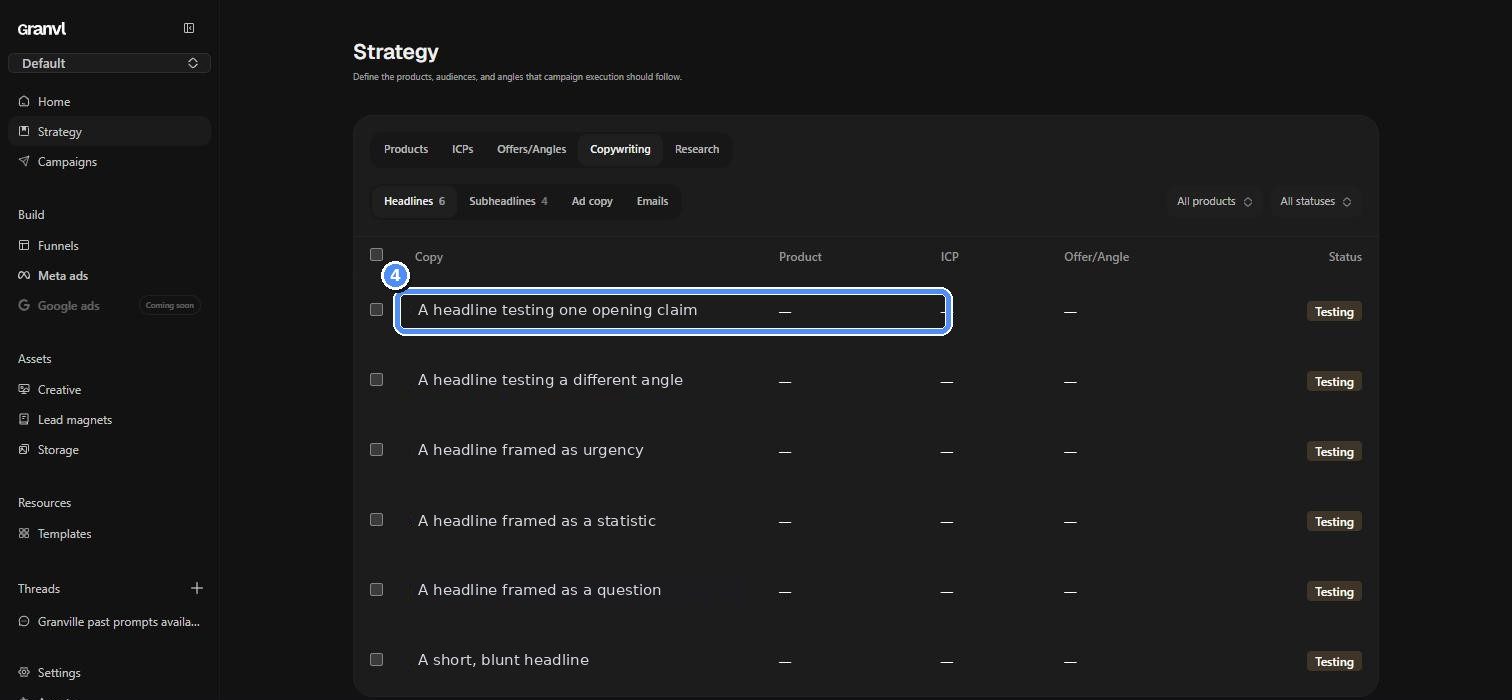
The Copywriting tab: every line, filterable by product, ICP, and angle